

The BEAMA Member Digital Newsletter – July 2025
🌐 July Newsletter from DSIN
Welcome, BEAMA Membership, to this edition of the Digital Strategy & Innovation Network (DSIN) newsletter. Whether you’re just beginning to explore digitisation or you’re already configuring APIs and schema, DSIN is your hub for collaboration, knowledge sharing and practical support.
This month’s DSIN newsletter brings you:
- Key structural updates from our kick off meeting
- A plain language primer on the EU Cyber Resilience Act (CRA) and its implications for UK exporters
- Highlights of BEAMA’s active roles in CEN/TC 442 WG 12, JTC 24 WG 1 and ISO/TC 154 WG 9
- Quantum Leap Ahead – discover the EU’s new quantum plan and why it matters for secure, connected digital systems.
- An in depth look at “Standards Unleashed” how digital authoring and SMART tagging are transforming standards into structured, future ready assets.
DSIN Kick-Off - Shaping BEAMA’s Digital Future Together
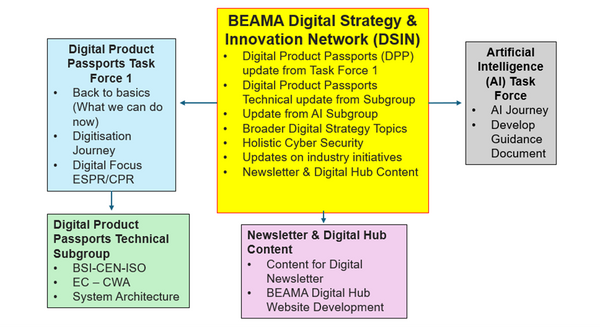
Thank you to everyone who joined our first Digital Strategy & Innovation Network (DSIN) meeting. We’re excited to be building this space together - one that supports all members, from those starting their digital journey to those deep into technical implementation.
Scope & Focus
Our work will span shared regulatory and digitisation challenges across BEAMA sectors. Sector-specific and sustainability topics remain supported by existing BEAMA groups.
Let’s continue to build a smart, collaborative digital future for BEAMA and our industry.
Together, we can turn strategy into action.
Participation is open to all members, to get involved or learn more, please contact Patricia Massey at [email protected].

EU Cyber Resilience Act (CRA) - What You Need to Know
The Cyber Resilience Act is an EU regulation that mandates baseline cybersecurity measures for products with digital elements placed on the EU single market. It entered into force on 10 December 2024 and will roll out in phases through December 2027
-
Scope: Any hardware or software whose normal use involves a direct or indirect connection to a network or device - such as industrial controls, IoT gateways, smart chargers or connected instrumentation.
- UK only devices: Products manufactured, sold and used exclusively within the UK - like domestic smart meters under the UK Smart Metering Implementation Programme - are not directly subject to the CRA unless those exact models are placed on the EU market.
- Exporters: If you sell into the EU, you must comply with CRA requirements, “security by design,” vulnerability handling and incident reporting - to affix the CE mark and trade legally.
Phased deadlines:
- 30 August 2026: Horizontal (Type A) products
- 30 October 2026: Vertical (Type B/C) products
- 11 September 2026: Reporting obligations begin
- 11 December 2027: Full application of all provisions
How These Rules Fit Together
The CRA doesn’t exist in isolation - here’s how it relates to other cybersecurity frameworks you may already know:
- Radio Equipment Directive (RED) An EU sector specific directive (2014/53/EU) covering radio and wireless devices, with emerging cybersecurity rules via Delegated Regulation 2022/30 (effective August 2025).
- Product Security & Telecommunications Infrastructure Act (PSTI) The UK’s domestic law for consumer “connectable” products, in effect since April 2024, requiring “secure by design” for UK only devices.
- Cyber Resilience Act (CRA) An EU horizontal regulation extending baseline cybersecurity obligations to all “products with digital elements” on the EU market, regardless of sector.
Key takeaway
- RED → EU only, radio focused with new cybersecurity requirements.
- PSTI → UK only, consumer connectable products under UKCA marking.
- CRA → EU only, horizontal cybersecurity for all digital products.
Have you read our BEAMA guide? Is your business struggling to make sense of the RED and PSTI requirements?
Coming soon - The DSIN will be incorporating CRA into a future holistic guide.
BEAMA at the Forefront of DPP Standards
We know the Digital Product Passport landscape can feel complex, both for manufacturers considering the requirements and for those of us building the systems behind them. Rest assured, you’re not alone on this journey. BEAMA and BSI are working hand in hand to smooth the path ahead.
As the British Standards Institution’s (BSI) appointed UK delegate, Patricia Massey represents GB on three pivotal international committees - while always championing BEAMA members interests -
- CEN/TC 442 WG 12 (“Digitalisation of construction product performance characteristics”), where we develop CPR enabled data templates and methodologies.
- CENCENELEC JTC 24 WG 1 (Strategic Advisory Group), defining the cross-sector framework and interoperability standards for Digital Product Passports.
- ISO/TC 154 WG 9 (Processes, data elements and documents in commerce, industry and administration), focused on best practices for managing standards as structured, machine-readable assets.
Our Mirror National Committee is also supporting the BSI Blog The EU Digital Product Passport is on the horizon | BSI
Got questions? We’re building an evolving BEAMA DPP Q&A—send your queries my way and let’s tackle the complexity together BEAMA DPP Q&A?
Quantum Leap Ahead, How Europe’s New Strategy Connects to Our Digital Journey
On 2 July 2025, the European Commission launched its Quantum Strategy, aiming to make Europe a global leader in quantum technologies by 2030.
These technologies use quantum physics principles, like superposition and entanglement to power next-generation computing, ultra-secure communication and highly accurate sensing.
The strategy focuses on five key areas:
🔹 Research & innovation (including pilot chip production)
🔹 Shared infrastructure (such as a European quantum internet)
🔹 Boosting private investment in start-ups
🔹 Applications in space and defence
🔹 Skills development, including a Quantum Skills Academy launching in 2026
Although quantum technology may feel remote, its emphasis on data security, interoperable systems and talent development closely aligns with our DPP, AI and broader digitisation initiatives.
Q: Quantum still feels a bit distant for most of us, but the EU is putting real weight behind it. From our perspective for example, smart metering and digital infrastructure, what could quantum technologies mean for BEAMA members down the line especially in terms of data security, interoperability or system readiness?
A: One immediate impact of quantum technologies will be encryption. We can expect truly random, quantum‑generated keys and built‑in data protection at the network level. For smart‑metering systems, that could mean far greater resilience against future “quantum‑computer” attacks and the ability to distribute keys securely across millions of devices without slowing down performance.
In terms of interoperability, quantum key distribution and post‑quantum cryptographic algorithms will need new standard protocols and interface layers. BEAMA members should start considering how meter gateways, head‑ends and IoT hubs will connect to quantum‑safe key‑management systems alongside existing security infrastructures.
Looking at system readiness, while full‑scale quantum networks are still emerging, early movers will need firmware‑upgradable hardware, engagement in national testbeds and active collaboration on standards to ensure they can roll out quantum‑resistant security modules smoothly as the technology matures.
DSIN will continue to monitor these developments as part of Europe’s wider digital shift, helping members stay informed about what’s coming next and where the future opportunities may lie.
Standards Unleashed – Turning Clauses into Intelligent Code
Are you on a standards committee or curious how standards are written these days? In today’s fast‑moving world, our approach to authoring technical standards has evolved too. Gone are the days of juggling multiple Word files and endless email threads - standards creation is stepping into the cloud, becoming more collaborative, transparent and future‑proof than ever before.
Imagine drafting standards not in clunky Word documents but in a sleek browser, where every clause is smart, machine-readable data - today’s reality, not tomorrow’s dream. As a member of CEN/TC 442/WG 12 (digitalisation of construction product performance characteristics), I’m using the Online Standards Development (OSD) (ISO/IEC OSD) platform - built on FontoXML - to help shape the next generation of standards under CPR and ESPR.
With OSD you get:
- Real‑time collaboration (goodbye version chaos)
- Auto‑numbering & cross‑refs that just work
- Instant QA checks on style and formatting
Flip on CEN CENELEC’s SMART overlay - where SMART stands for Specific, Measurable, Achievable, Realistic, Timebound and each clause is wrapped in hidden XML. That means your text stays plain English for easy reading, yet under the hood it’s fully structured, searchable and future-proofed. From automated quality checks and in-line commenting to cross-sector data sharing and next-generation regulatory tools, you’ll have everything you need to hit the ground running.
Get involved!
DSIN is your platform.
Patricia Massey
Digital & Technology Manager, BEAMA
Thank you for your continued engagement.
We look forward to working with you as we navigate these exciting changes and opportunities together.